
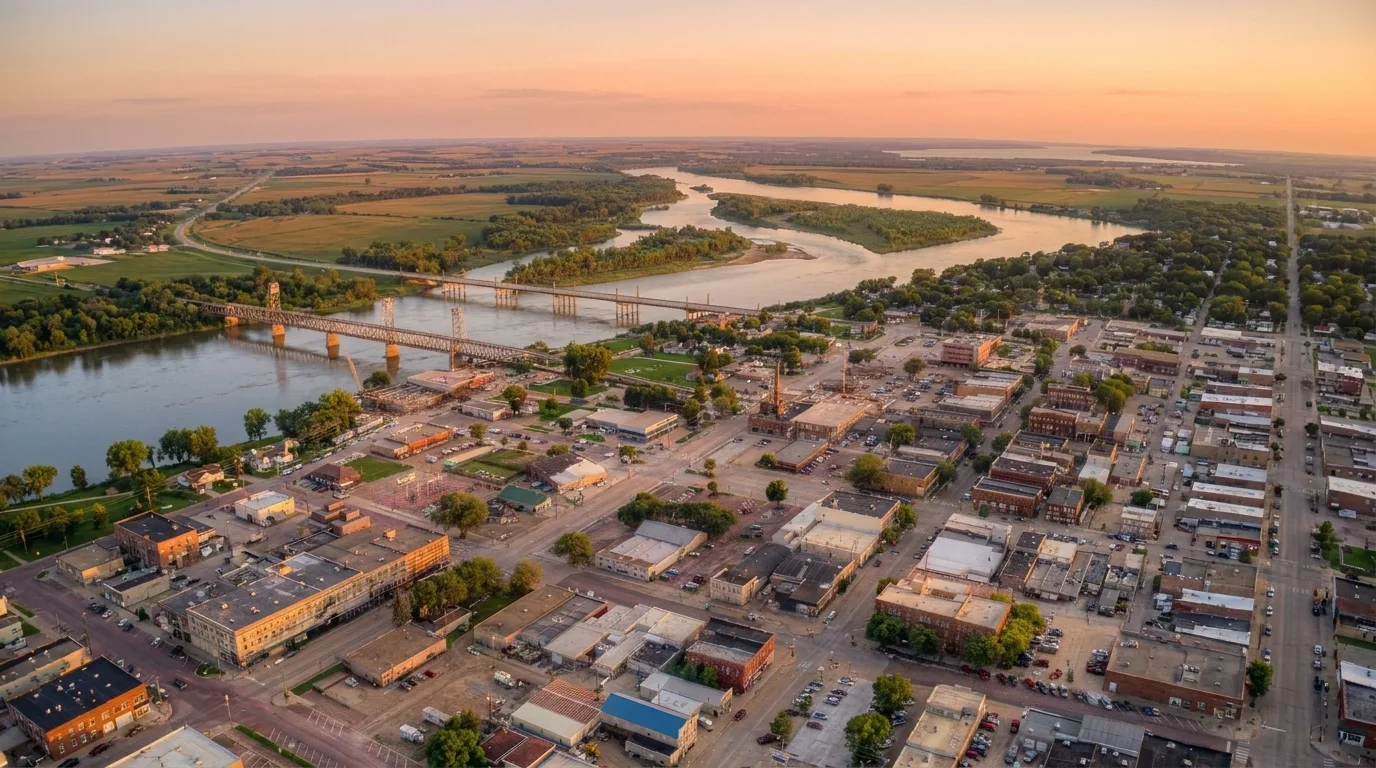
The SE SD commercial market in 2025 - retail, office, industrial, mixed-use
Industrial: Bender Commercial's 2026 Sioux Falls industrial outlook shows record-year sales activity with rising vacancy as new warehouse and distribution space comes online. E-commerce-driven logistics demand keeps rents rising, though not at pandemic-era spikes.
Retail: Sioux Falls and Yankton both see relatively tight retail vacancy by national standards. Lifestyle-, grocery-, and essential-service-anchored centers lease more reliably than older strip malls. Downtown Vermillion and Yankton stay small but stable - restaurants and professional services fill most of the Class B retail.
Office: Sioux Falls office vacancy hovered around mid-11% in 2025 - still below the national average despite the post-2020 soft patch. Flexible, hybrid-ready blocks and suburban medical-professional offices lease more steadily than big legacy downtown footprints.
Mixed-use: in Sioux Falls and growing suburbs like Tea and Harrisburg, mixed-use pads (small retail plus upstairs apartments or offices) are creeping into the pipeline, especially near I-29 and I-229. Industrial and well-located retail are the most stable plays; office works if you're comfortable with 6–10% vacancy risk.
Owner-user vs. investor purchases
Two clear camps in southeast SD: business owners buying their own pads, and investors stacking multi-tenant retail, strip, and industrial.
Owner-users: local and regional employers, banks, manufacturers, and medical or professional offices in Sioux Falls, Tea, Harrisburg, and Yankton buy existing buildings to occupy and grow, sometimes with vacant pads for future expansion. They care less about a perfect cap rate than about parking, utilities, zoning, and future-expansion room on the same parcel.
Investors: out-of-state and regional REITs, private equity, and local syndicators park capital in fully or partially leased retail, light-industrial, and small-office strips in Sioux Falls and Yankton - chasing 6–9% cap rates depending on tenant credit and lease length. Strong credit tenants (national grocers, national pharmacies, big-box home improvement, flagship Sanford/Avera-affiliated clinics) command lower cap rates with more conservative underwriting.
Many SE SD deals are hybrids: an owner-occupying anchor tenant (bank, clinic, grocer) with 1–2 small tenants in the same pad-park - combining user-needs stability with investor-level income.
Financing - SBA 504, SBA 7(a), and local SD banks
Lending is local, but federal programs underpin most southeast SD deals.
SBA 504 (CDC loans): finances major fixed assets - real estate, machinery, site improvements - for privately owned for-profit companies. Typical structure: 50% private-bank loan, 40% SBA 504, 10% borrower equity, 20-year fixed rate on the 504 portion.
SBA 7(a): can cover up to 100% of real estate, construction, or equipment cost, but most lenders still want 10–25% equity. Widely used in Sioux Falls by small-business owners buying their own buildings in manufacturing, healthcare, and retail.
SD-focused programs: GROW South Dakota runs a statewide business-lending program that can finance real estate, equipment, inventory, and working capital - often partnering with local banks. First PREMIER Bank, First Bank & Trust, and Cortrust are active CRE lenders in the Sioux Falls corridor, providing construction loans and SBA-backed packages.
Market-rate CRE debt currently starts around 6.0–6.5% for investment-class retail and light industrial at 65–75% LTV. Owner-occupied business real estate can reach 80–90% LTV with strong cash flow and a track record.
Industrial corridor reality - north Sioux Falls, Tea, Harrisburg, Yankton
Follow the freight, the workforce, and the utilities.
Sioux Falls north industrial: the I-229 industrial and distribution corridor draws logistics, manufacturing, and e-commerce warehousing. Large parcels and pads attract national-scale tenants. Public/private partnerships including TIF-backed infrastructure have helped Smithfield and others build out plants and distribution centers.
Tea / Harrisburg light industrial: growing flex-space belts for Sioux Falls with easier zoning, ample land, and improving highway access. Harrisburg Industrial Park hosts Showplace Cabinetry, Hurco, and others - the corridor is absorbing logistics and light-manufacturing demand from the metro core.
Yankton industrial park: supports food processing, manufacturing, and distribution, anchored by regional employers and cooperatives. For an investor or small-business owner, Yankton is a more affordable, lower-noise alternative to Sioux Falls with slower-but-steadier growth.
For industrial buyers anywhere in the corridor, focus on fully entitled pads with utilities to the line, Class-A or light-industrial zoning, and easy highway access.
Retail - downtown Vermillion, downtown Yankton, Sioux Falls 41st & Empire
Southeast SD retail is a mix of lifestyle-anchored suburbs and small-town downtowns.
Downtown Vermillion is small but stable - restaurants, banks, professional offices, and USD-driven foot traffic fill Class B retail blocks. Long-term investors usually buy small mixed-use blocks (street-level retail with apartment or office above) and hold; gross-to-net lease terms are modest because vacancy is low but traffic is finite.
Downtown Yankton features banks, restaurants, and small-town-anchor retailers along Broadway. As a county seat and river town it's relatively insulated from big-box competition, but growth runs slower than the Sioux Falls corridors.
Sioux Falls 41st Street and the Empire Mall area are the region's dominant retail spine - national grocers, big-box, lifestyle shopping, and medical-office pads. These belts absorb most of the regional retail cap-rate money, with NNN-anchored pads trading in the 6–8% band depending on tenant mix and lease expirations. Sioux Falls grocery-anchored or lifestyle-anchored pads are the most liquid and bankable; Vermillion and Yankton downtowns suit patient long-hold strategies.
Triple net vs. modified gross leases - what's typical in SD
Most southeast SD landlords go either NNN (triple-net) or modified gross. Pure gross-only leases are rare.
Triple-net (NNN): common for single-tenant retail, freestanding pads, and industrial warehouses. The tenant pays base rent plus a pro-rata share of property taxes, insurance, and CAM. The landlord's income stream is more predictable and operating costs are largely passed through.
Modified gross: typical in multi-tenant retail strips, suburban office parks, and mixed-use pads. The landlord absorbs a base-year level of operating expenses; the tenant reimburses any increases in a pre-negotiated structure. Balances tenant control and landlord cost-pass-through.
In Sioux Falls, Tea, Harrisburg, and Yankton, NNN is the norm for credit-tenant single-tenant pads; modified-gross is standard for shared-park retail and smaller-office environments.
Property tax and TIF in Sioux Falls and Yankton
South Dakota real estate is taxed under SDCL Title 10, with local governments and school districts setting mill levies. Both Sioux Falls and Yankton use TIF districts to help finance targeted redevelopments.
Property tax basics: industrial, retail, and office properties are assessed at market value and taxed at local mill rates that include school, county, and municipal components. Industrial projects in Sioux Falls can benefit from aggressive cost-containment via TIF, especially when they generate new wastewater-treatment or utility-infrastructure capacity.
Sioux Falls TIF: multiple districts, most visibly around Smithfield's new plant and related industrial corridors. The increment - added tax revenue from the new improvement - pays back developer costs for site prep, infrastructure, and other qualifying expenses over 15–20 years.
Yankton and Yankton County also use TIF for targeted downtown and industrial-park upgrades at smaller scale than Sioux Falls. For a commercial buyer or developer, participating in a TIF project can reduce upfront infrastructure costs but locks you into a long-term tax structure - knowing whether a parcel sits inside a TIF and how many years remain on the increment schedule is part of due diligence.
Frequently asked questions
How is commercial real estate priced in South Dakota?
On cap rate, not a per-square-foot guess. Divide net operating income (NOI) by sale price for the cap rate. In SE SD, prime credit-tenant-anchored assets often trade around 5–7%, while more speculative or older retail/office sits in the 7–9%+ band.
What's the difference between NNN and gross lease?
NNN: tenant pays base rent plus pro-rata share of taxes, insurance, and CAM. Common in single-tenant retail and industrial. Gross / modified gross: landlord absorbs base-year operating costs and passes through increases. Typical in multi-tenant retail and office.
Are there TIF districts in Sioux Falls?
Yes - multiple, especially in industrial and wastewater-infrastructure projects like the Smithfield plant and its corridors. Future-property-tax increment helps repay eligible development costs over 15–20 years.
What's a typical cap rate for SE SD retail?
Grocery-anchored or strong-retail pads in Sioux Falls and Yankton are roughly 6–8% in 2025, depending on tenant strength, lease length, and location. Smaller downtown retail or purely local-tenant strips can creep toward 8–10% on lower traffic and higher turnover risk.
Do I need a SD broker for an out-of-state commercial purchase?
Not legally required, but a local broker with NAI or SIOR-level networks is essential for navigating zoning, TIF districts, utility planning, and local financing relationships. SD brokers also understand SBA eligibility and how First PREMIER, First Bank & Trust, and Cortrust approach CRE deals.
Sources Bender Commercial - Sioux Falls market research · Sioux Falls Development Foundation · SD Department of Revenue - TIF annual report · GROW South Dakota · SBA 504 program overview · SDCL Title 10 - Taxation
Related South Dakota resources

Work with Michelle Maloney
Bring Michelle the town, property type, timeline, and the decision you are stuck on. She will help you compare Sioux Falls, Vermillion, Yankton, Tea, Beresford, Elk Point, and the Sioux City corridor against the way you actually need to live or sell.