
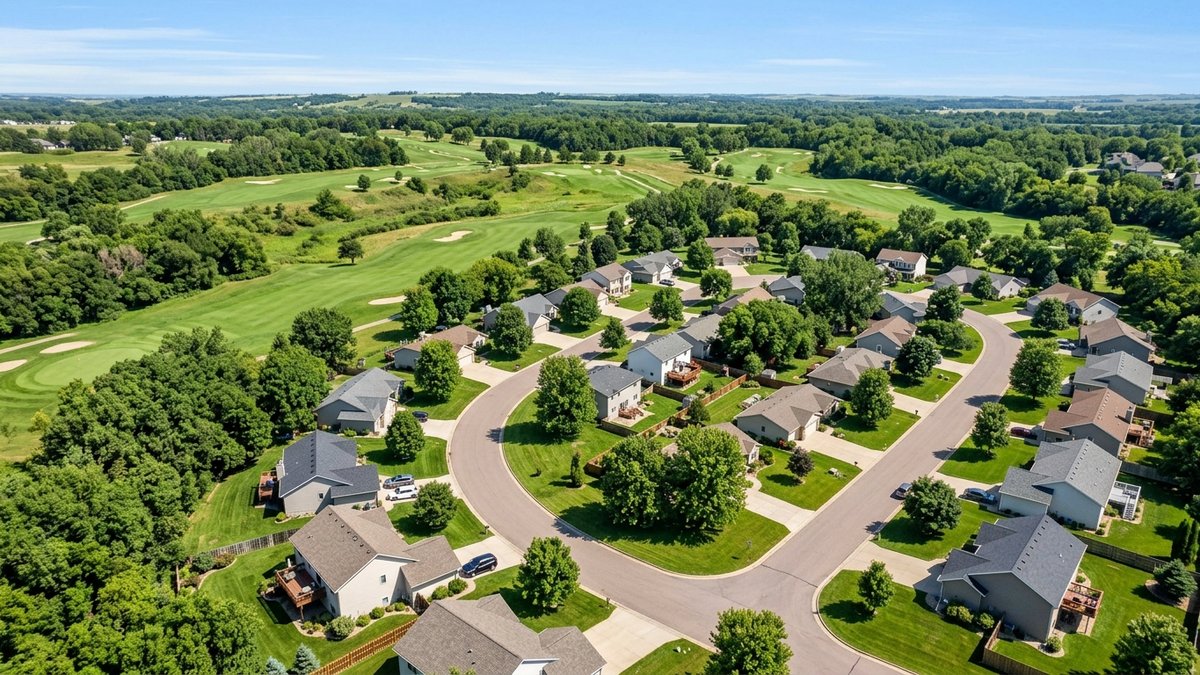
What is a building eligibility in Minnehaha County?
It’s how Minnehaha County limits the number of houses on its farmland. The county’s Planning and Zoning FAQ and its comprehensive plan both describe zoning that caps how many houses can go on agricultural land.
The practical rule follows from that. Before a house can be built in the unincorporated parts of the county, a residential building eligibility must be available for the property. The county’s transfer packet says so directly, and the zoning ordinance permits a single-family home in the A-1 Agricultural District if its building eligibility provisions are met.
The county’s Envision 2045 Comprehensive Plan calls this density zoning and says the rules generally allow one building eligibility per forty acres or per lot of record at the time of the law. The zoning ordinance gives each quarter-quarter section in the A-1 district one building eligibility when its conditions are met.
So the buyer’s question is whether this parcel has an eligibility available to use, and what has already used it.
If you’re relocating and picturing a few acres in the country outside Sioux Falls, that question comes before the view, the price or the drive into town. A listing photo can’t tell you the answer, and neither can the size of the parcel on its own.
There’s a second catch for people moving from a city: the neighbors. Both the county’s comprehensive plan and the covenant text in its zoning ordinance describe dust, noise and odors as part of living near working farmland. If you’re picturing a quiet country lot, read the covenant text before you fall for the view.
Is there already a house on the same 40 acres?
Check this first, because one of the A-1 conditions turns on what is already on the land: there can’t be another dwelling on the same quarter-quarter section. The comprehensive plan describes the result as one house on every forty acres.
That means a farmhouse on the same 40 acres may already account for that quarter-quarter’s eligibility. If a listing is a split parcel near an existing farmstead, ask about this before anything else.
Don’t try to judge this from the road. Ask the seller or Planning and Zoning which quarter-quarter the parcel sits in and whether any house stands on it today, including an older farmhouse set back from the road or a house on a neighboring parcel that falls within the same 40 acres. A parcel can look isolated in a listing photo and still share its quarter-quarter with a home you can’t see from the gate.
Then ask Planning and Zoning to walk you through the rest of the A-1 rules for that parcel. It also helps to ask the question the other way around. Instead of asking whether a house is allowed, ask the county what would have to be true for a house to be allowed on this specific parcel, and write down the answer.
What about a smaller parcel split off years ago?
A lot of record can carry its own eligibility. Both the ordinance and the comprehensive plan tie eligibility to the lot of record as well as to the 40-acre quarter-quarter.
That’s why two similar-looking parcels on the same road can be different purchases. One may be an older lot of record. The other may be a newer split that depends on the quarter-quarter’s eligibility. How and when the parcel was created matters, so ask the county which rule applies.
Don’t sort that out from a listing description. Ask the seller for the legal description and how the parcel was created, and take both to the county.
It helps to ask for the paper trail, not just a summary. A copy of the deed, any recorded plat, and any county approvals the seller has received give Planning and Zoning something concrete to look at. If the seller bought the land from a family member or split it off recently, ask when the split happened and whether the county was involved. Those answers can help the county see which part of the ordinance applies.
Two quick examples
These are made-up situations to show how the questions work, not rulings on any real parcel.
- Five acres carved off a farm. A seller splits five acres from a 40-acre quarter-quarter where the farmhouse already stands, and lists it as a building site. The first thing to ask the county is whether the farmhouse already uses that quarter-quarter’s eligibility, and if so, what other path, if any, the parcel has.
- A bare 40 acres. A full quarter-quarter with no house on it may still have its one eligibility. That’s the parcel to check against the rest of the ordinance’s conditions before you count on building.
Can a building eligibility be moved to the parcel you want?
Sometimes. The transfer packet says transfers of building eligibilities in the unincorporated area may be approved by the Minnehaha County Planning Commission through a conditional use permit. The ordinance lists the transfer of a building eligibility as a conditional use, and both the packet and the ordinance say the parcels must be contiguous.
Treat a transfer as a question to answer before you buy. If a seller says an eligibility can be moved over, ask:
- Which parcel holds the eligibility now? Get the parcel and its legal description.
- Is that parcel next to the one you’re buying? The rules require contiguous parcels.
- What has to be filed, and by whom? Ask Planning and Zoning what the application needs and who must sign it.
- What is the timeline? Ask when the next hearing is and how that lines up with your purchase dates.
If the parcel you want only works with an eligibility moved from next door, ask your agent and, if needed, a South Dakota real estate attorney: Who will apply? Who pays for the application? How would the contract handle a county denial?
What should you check before you buy rural land near Sioux Falls?
Start by confirming the parcel is in unincorporated Minnehaha County, because that decides whose rules apply. If you’re moving from out of state, these calls don’t require a trip, so they’re a good first step before you plan a visit to walk the land. Then work through the eligibility with the county:
- Call Planning and Zoning with the legal description. Ask whether an eligibility is available for the parcel, and whether a house elsewhere on the same quarter-quarter or lot of record has already used it.
- Ask about each condition. Go through the A-1 rules for that parcel with the office so nothing surprises you after closing.
- Ask for paperwork, not just a yes. If the county has already approved a conditional use or a transfer for the parcel, ask for a copy and keep it with your purchase file.
- Write down the answers. Note who you spoke with and the date, and share the notes with your agent so the questions carry into the contract stage.
- Check the neighbors. Drive the roads around the parcel at different times of day, look at what’s farmed nearby, and ask the seller what operations run close to the property and when.
Once the eligibility checks out, the rest of the acreage work still matters. Our guide to restrictive covenants on a South Dakota home or acreage covers another layer of rules that can limit what you build, and verifying property boundaries and private-road access cover two of the next questions. If the plan is to build, our guide to South Dakota’s contractor’s excise tax is the next read.
Frequently asked questions
Why does Minnehaha County limit houses on farmland?
Both the county's zoning ordinance and its comprehensive plan describe the same aim: keeping houses from spreading across agricultural land so that farmland is preserved.
Why does July 10, 1979 matter for a lot of record?
Both the county's zoning ordinance and its comprehensive plan use that date when they describe lots of record. The plan's density zoning diagram uses it to separate older lots of record from later lot splits. Ask the county how it applies to a specific parcel.
Do the county's rules apply inside Sioux Falls or another city?
No. The county Planning and Zoning office says it only has jurisdiction in the unincorporated area, and the county zoning ordinance applies to unincorporated land except areas approved for municipal joint zoning jurisdiction. Inside a city, ask that city about zoning and building.
What is the Right to Farm covenant?
It's a notice the county requires for new houses built in its agricultural areas. It tells the owner the property is in or near agricultural operations.
SourcesMinnehaha County, 1990 Revised Zoning Ordinance MC16-90 (as amended), Article 3.00 A-1 Agricultural District · Minnehaha County, Envision 2045 Comprehensive Plan (Rural Conservation, Housing Density) · Minnehaha County Planning and Zoning, Transfer of Building Eligibility Application Packet · Minnehaha County Planning and Zoning, Frequently Asked Questions
Related South Dakota resources

Work with Michelle Maloney
Bring Michelle the town, property type, timeline, and the decision you are stuck on. She will help you compare Sioux Falls, Vermillion, Yankton, Tea, Beresford, Elk Point, and the Sioux City corridor against the way you actually need to live or sell.