
How many chickens can you keep at a Sioux Falls home without a license?
Six, counting rabbits, and none of them can be a rooster. Sioux Falls allows up to six chickens and rabbits combined on personal land without a license, and the city prohibits roosters outright. That ceiling is the first thing to hold up against your plans, because it is a combined count and not six of each.
If you are moving from a place with looser rules, or from acreage where nobody counted, six can feel small. Count the flock you want. Four laying hens and two rabbits for the kids already put you at the line. A flock that grows each spring, or a trio of hens plus a few chicks you planned to raise, can cross it before you notice.
If you figured a rooster would be fine as long as the neighbors did not mind, Sioux Falls does not leave that to the neighbors. The code bans roosters, and even the license that raises the bird count leaves that ban in place. If a rooster is part of your plan, a lot inside city limits is the wrong fit, and you would be looking at property outside the city with its own rules to check.
Ducks, geese and turkeys work differently from chickens. They are not covered by the six-animal allowance at all. Keeping any of them, even one, takes a city license. So a buyer who pictures a couple of ducks on a backyard pond is already in license territory on day one.
Whether a particular house works depends on the lot, the zoning and the neighbors, and the coop is usually where a plan meets the property.
What changes if you want more birds or a few ducks?
You need a city license, and the license depends on your neighbors. Anyone who wants more than six chickens and rabbits, or any ducks, geese or turkeys, has to apply through the city, and the application needs written consent from neighboring landowners. Ask Animal Control when to apply relative to buying the animals, because the timing matters if you are bringing birds with you.
For a buyer, that consent is the catch. You are asking people you have not met yet to sign for something that affects their yard. A seller with a large flock may have had friendly neighbors who signed years ago. That history does not mean the same neighbors will sign for you, and it does not mean the people next door are the same people.
Unless you already know the neighbors and they have agreed to sign, consent is still an open question when you write an offer. If one owner says no, the extra birds do not happen. If your plan depends on more than six birds or on ducks, part of the reason you chose the house rests on signatures you do not have yet.
There are a few ways to lower that risk. Ask the seller whether they hold a city license now and how it went with the neighbors. Look at the houses around the lot during a showing and notice how close they are. Call Animal Control before you write an offer and ask which neighboring owners would have to sign for that address and what the application involves. Those answers will not guarantee consent, but they tell you how big the bet is.
If six chickens and rabbits are enough for you, none of this applies. That is a reasonable way to plan. Keep the flock at or under the no-license ceiling and the neighbor question goes away. The coop still needs a permit and a spot that fits the lot, so read the next section either way.
Where can a coop sit on a Sioux Falls lot?
At least 25 feet from any house on a neighboring lot, and only after the city issues a permit to place it. The city’s Urban Livestock page sets that distance for coops, and the zoning rules for detached-dwelling forms such as DD4 and DD5 use the same 25 feet. On a narrow city lot with houses close on both sides, that distance can rule out most of the backyard.
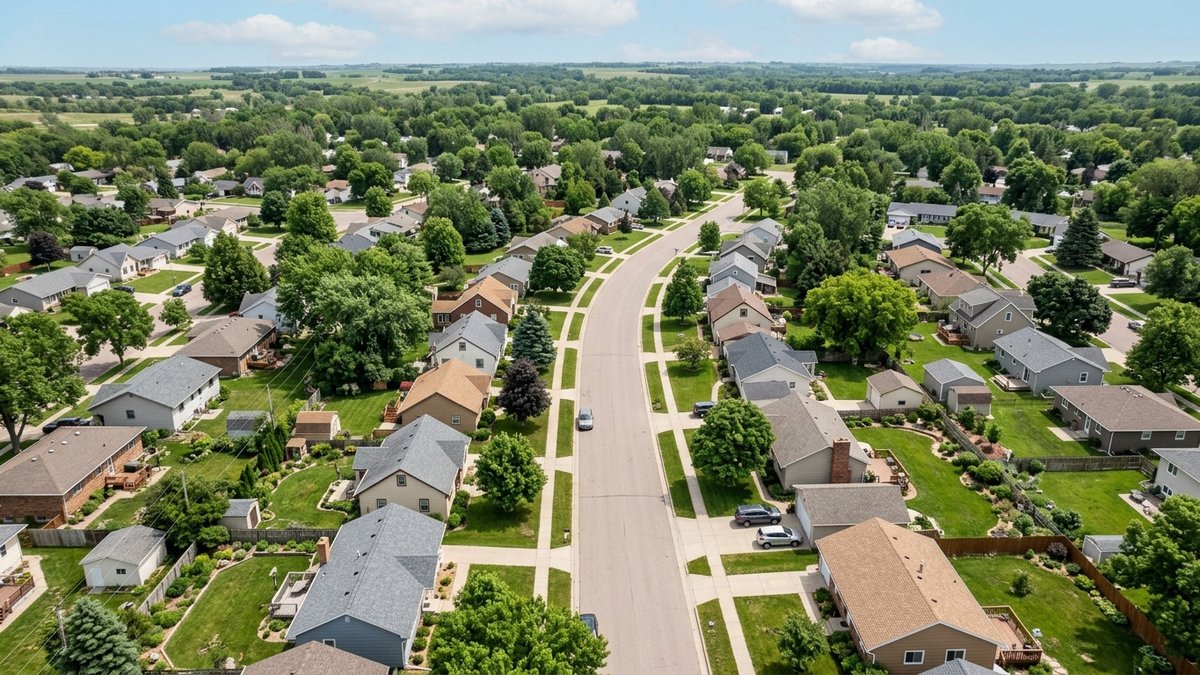
Measure it before you fall for the yard. Stand at the back of the lot and look at where the neighboring houses sit, not the property lines. The 25 feet run from the coop to the neighbor’s dwelling. On a lot with a deep backyard, a spot near the middle of the back may work. On a shallow lot, or one where a neighbor’s house sits near the shared line, there may be no legal spot at all. An aerial view or a plat can help you sketch it. Then ask the city’s Zoning office about placement for that specific address.
Size changes the paperwork. A one-story coop of 200 square feet or less needs no building permit, but it still needs a placement permit from the city’s Zoning division and has to follow the placement rules for accessory buildings in Section 160.507 of the zoning code. A larger coop also has to meet the residential building code.
If the house already has a shed, a detached garage or a play structure in the backyard, those take up some of the space a coop would need. Look at what is already back there and where it sits.
A coop that came with the house deserves its own questions. Ask the seller whether it was permitted and when it was built. Ask how far it sits from the nearest neighboring house. A coop that is too close, or that went up without a placement permit, is something to sort out before closing rather than after you have birds in it.
Can a Sioux Falls home come with goats or beehives?
Goats need agricultural zoning, and hives need their own city permit and a state registration. Those are separate rules from chickens, and they catch buyers who assume backyard animals all work the same way.
Livestock first. Sioux Falls treats goats as livestock, along with cattle, sheep, horses and pigs. The city allows livestock only on property zoned AG, Agricultural District. A residential lot qualifies only if it carries that classification, however large the yard looks. If you want goats or a horse and still want a Sioux Falls address, ask the Zoning office for the property’s classification before you get attached to it. For land outside the city where livestock is the main plan, the acreage checks for horses and livestock walk through a different set of questions.
Bees come next. Sioux Falls requires a city permit before anyone sets up a hive, and hives are allowed only on certain zoning forms. For most home buyers, the forms that matter are DD (Detached Dwelling) and AD1 (Attached Dwelling). On those lots, the first application needs written consent from neighboring owners.
The seller’s city permit does not transfer to you or stay with the property. Before keeping hives the seller leaves behind, you need your own permit and must meet the city’s initial-application requirements. On DD and AD1 lots, that includes the required neighboring-owner consents. Check those requirements with Animal Control before closing.
The state adds its own step. South Dakota law requires anyone who owns or possesses bees to register each apiary with the Department of Agriculture and Natural Resources before February 1 each year. A new owner has ten days after acquiring bees to register them. That matters if a seller offers to leave hives behind. State registration does not replace your city permit.
So a listing that shows hives in the yard is not proof that you can keep them. Treat them like any other item the seller wants to leave. Decide whether you want them, then check with the city about the permit and plan for the state registration before closing.
What should you check on a specific listing before you write an offer?
Check the zoning, the measurements and the neighbors, in that order. The city rules above apply inside Sioux Falls city limits, so start by confirming the address is in the city. Then work through the property itself.
Start with zoning. Ask the city’s Zoning office what form and district the lot carries. That answer tells you whether goats are possible (only with AG zoning), and it gives you what you need to ask Animal Control whether a hive is allowed there.
Then measure. Find where a coop could go and check the 25 feet to each neighboring house. Note any existing sheds or garages in the backyard. If the house already has a coop, ask for its permit and its distance from the nearest house. A short walk around the lot during a showing answers more than the listing photos will.
Then think about the neighbors. If your plan stays at six chickens and rabbits or fewer, with no ducks and no rooster, you do not need anyone’s signature for the birds. If it goes beyond that, you need a license with written consent from neighboring landowners. Treat that consent as unresolved until you have it, and weigh that before you choose a house for its backyard.
Two more checks round it out. If the lot sits in a subdivision with recorded covenants, read them for anything about animals or outbuildings, and the covenant review guide covers how to find them. If you are still choosing a part of town, the Sioux Falls community overview is a starting point for comparing areas before you look at specific lots.
City rules can change. Confirm the current version with Animal Control and the Zoning office before you rely on a detail, and if a backyard flock or hives are part of why you want a particular house, raise it with your agent early so the questions get asked before the offer goes in.
Frequently asked questions
Do I need a permit for six hens in Sioux Falls?
Not for the birds. The city allows up to six chickens and rabbits combined without a license. The coop is a separate question, because the city requires a permit to place one.
Can I keep a rooster in Sioux Falls?
No. The city code prohibits roosters, and the license that allows more than six birds does not change that.
Do rabbits count toward the six-chicken limit?
Yes. The city's limit covers chickens and rabbits together, so four hens and two rabbits reach the same six-animal ceiling.
Can I keep goats on a Sioux Falls lot?
Only on property zoned AG, Agricultural District. The city treats goats as livestock along with cattle, sheep, horses and pigs.
What if the seller leaves beehives behind?
Talk to the city before closing. The seller's beekeeping permit does not transfer with the house, so you need your own city permit before keeping the hives. South Dakota also requires anyone who acquires bees to register them with the state within ten days.
SourcesCity of Sioux Falls, Urban Livestock · Sioux Falls Code of Ordinances, Section 90.008 Keeping of Animals · Sioux Falls Code of Ordinances, Section 90.078 Licensing of Animals and Fowl · Sioux Falls Code of Ordinances, Section 90.100 Beekeeping Permit Required · Sioux Falls Code of Ordinances, Section 160.093 Accessory Uses · Sioux Falls Code of Ordinances, Section 160.103 Accessory Uses · Sioux Falls Code of Ordinances, Section 160.507 Location of Accessory Buildings · Sioux Falls Code of Ordinances, Section 150.002 Residential Code Amendments · South Dakota Codified Laws 38-18-3, Registration of Apiaries · South Dakota Department of Agriculture and Natural Resources, Apiary Program
Related South Dakota resources

Work with Michelle Maloney
Bring Michelle the town, property type, timeline, and the decision you are stuck on. She will help you compare Sioux Falls, Vermillion, Yankton, Tea, Beresford, Elk Point, and the Sioux City corridor against the way you actually need to live or sell.